
 By
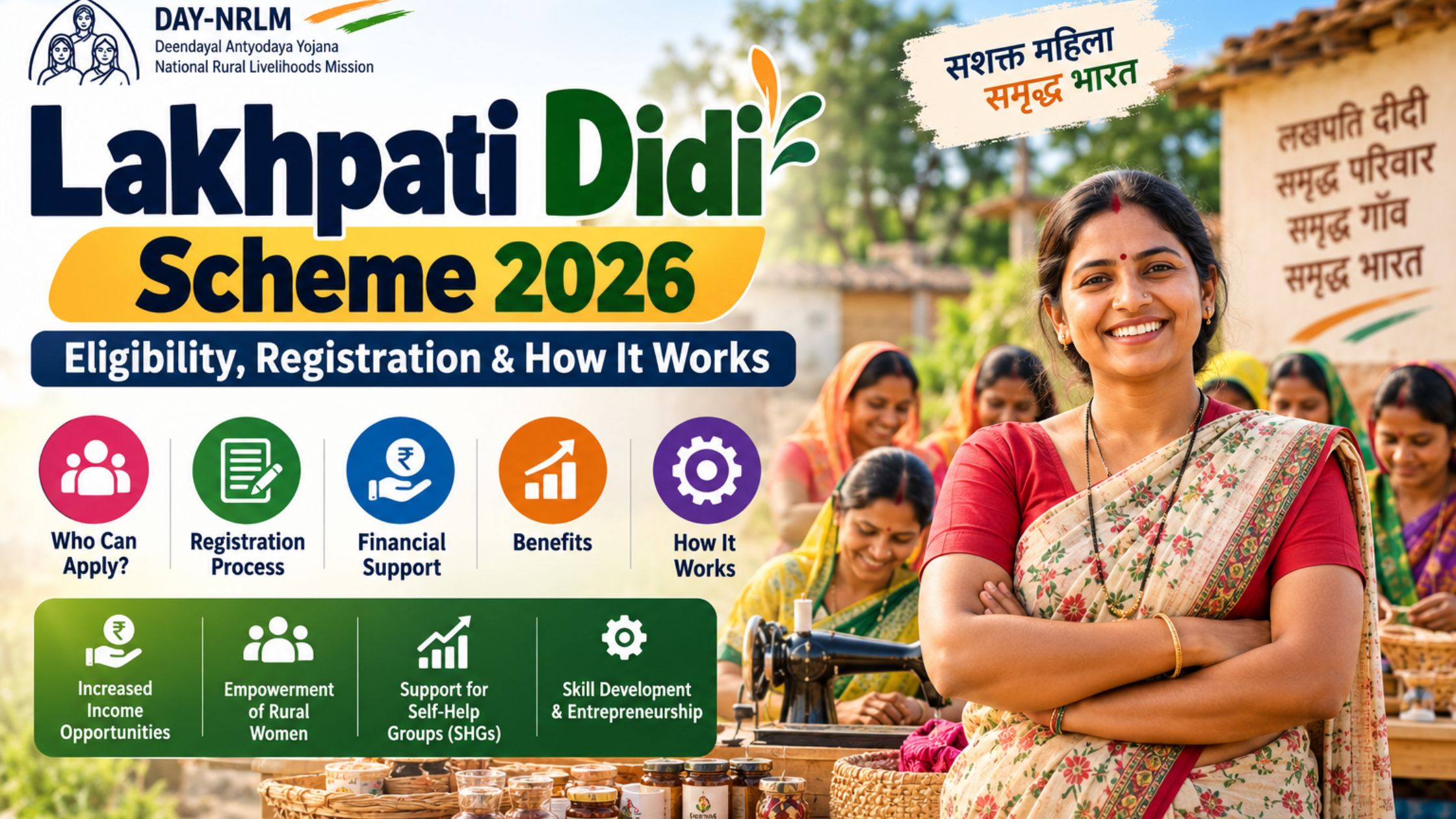
Lakhpati Didi Scheme 2026: Eligibility, Registration & How It Works
Across rural India, millions of women already save, borrow, and manage money together through Self-Help Groups but turning that collective discipline into a real, individual income of ₹1 lakh a year has always been the harder part. The Lakhpati Didi Scheme was built to close exactly that gap, and in 2026 the government isn’t just continuing it it’s doubling down. The target was raised from 3 crore to 6 crore “Lakhpati Didis” by March 2029, after the original goal was hit a year ahead of schedule.
Here’s what the scheme actually offers, who qualifies, and how to register through your local SHG.
What Is the Lakhpati Didi Scheme?
Launched by the Prime Minister in his Independence Day address in August 2023, the scheme runs under the Deendayal Antyodaya Yojana – National Rural Livelihoods Mission (DAY-NRLM), operated by the Ministry of Rural Development. The core idea: help women already part of Self-Help Groups build a sustainable annual household income of ₹1 lakh or more — not through a one-time payout, but through skill training, market access, and structured credit support for small enterprises.
A woman who crosses this ₹1 lakh annual income threshold through her own economic activity is recognized as a “Lakhpati Didi.”
Lakhpati Didi Scheme: Quick Facts
| Detail | Information |
|---|---|
| Launched | 15 August 2023 |
| Nodal Ministry | Ministry of Rural Development |
| Implementing Framework | DAY-NRLM |
| Original Target | 2 crore (raised to 3 crore in Budget 2024) |
| Current Target | 6 crore by March 2029 |
| Target Achieved So Far | 3 crore+ (reached ahead of schedule) |
| Lead State | Madhya Pradesh |
| Key Sub-Scheme | Namo Drone Didi |
Eligibility Criteria — Who Qualifies
- Must be an Indian citizen, generally applying as a resident of the state where the SHG is registered.
- Must be an active member of a women’s Self-Help Group — most guidelines require the SHG to have been functional for at least 2 years.
- The SHG itself should ideally already be linked to a bank (SHG-Bank Linkage Programme) or be in the process of linkage.
- Priority is typically given to women who are not currently earning ₹1 lakh/year but show potential through an existing or proposed micro-enterprise (tailoring, dairy, food processing, handicrafts, agri-based work, etc.).
- There is no separate individual “application form” beyond your SHG’s own enrollment — eligibility flows through your group’s registration and micro-business plan.
How the Financial Support Works
Unlike a direct cash-transfer scheme, Lakhpati Didi works by routing multiple existing credit and training channels through your SHG:
| Support Source | What It Provides |
|---|---|
| Community Investment Fund (DAY-NRLM) | Seed/working capital support to SHGs |
| SHG-Bank Linkage Programme | Collateral-free bank credit for SHG members |
| MUDRA Loans | Micro-credit for individual enterprise expansion |
| NABARD Rural Financing | Refinancing support routed through banks |
| Mahila Kisan Sashaktikaran Pariyojana (MKSP) | Skill and capacity-building for agri-based livelihoods |
| Stand-Up India | Additional credit access for women entrepreneurs |
Loans routed through this ecosystem typically carry an interest rate around 7% per annum, often reduced effectively to around 4% for groups with a strong, prompt repayment record — though exact terms vary by bank and state.
Namo Drone Didi — The Newer, Higher-Income Component
One of the most distinctive parts of the scheme is Namo Drone Didi, where selected SHGs receive agricultural drones and training to operate them. Women trained under this component earn by renting drone services to farmers for pesticide spraying, crop monitoring, and land mapping — with reported average earnings in the range of ₹1.5–3 lakh per drone per year, making it one of the faster routes to crossing the Lakhpati threshold. Around 15,000 SHGs are covered under this component, with training conducted through PMKVY and other skill-development programmes.
Step-by-Step: How to Register
- Confirm your SHG membership — you must already be, or become, a member of an active women’s Self-Help Group in your area. If you’re not part of one yet, contact your local Anganwadi centre or Gram Panchayat office to find active SHGs near you.
- Check SHG bank-linkage status — ask your SHG’s leader/facilitator whether the group is already linked under the SHG-Bank Linkage Programme; if not, this is usually the first step your group coordinator will help arrange.
- Get onboarded onto the Udyam Assist Platform — verified beneficiaries are registered here as recognized micro-entrepreneurs, which helps with future credit and scheme access.
- Attend skill/livelihood training — through DAY-NRLM or state rural livelihood missions, based on the enterprise your SHG chooses (tailoring, food processing, dairy, drone piloting, etc.).
- Access credit through your SHG — working capital or expansion loans are routed through the Community Investment Fund, MUDRA, or bank linkage — not applied for individually on a separate portal.
- Track your group’s progress — status and monitoring reports can be checked on the official portal, nrlm.gov.in.
Common Questions on Getting Started
Is there a separate application form for individuals?
No — there’s no standalone individual application. Enrollment happens through your Self-Help Group; your group facilitator or Anganwadi worker guides the process.
Do I need to already run a business to qualify?
No. Many women join with no existing enterprise and are trained and supported into one through the scheme’s skill-development and credit components.
Is the ₹1 lakh income guaranteed?
No — it’s a target outcome supported through training, market linkage, and credit, not a fixed cash transfer. Actual income depends on the enterprise, effort, and local market conditions.
FAQs
What is the current target of the Lakhpati Didi Scheme?
6 crore women by March 2029, after the earlier 3 crore target was achieved ahead of schedule.
Which ministry runs the Lakhpati Didi Scheme?
The Ministry of Rural Development, through the DAY-NRLM framework.
Can any woman apply individually?
Enrollment works through active Self-Help Group membership rather than a separate individual application.
What is Namo Drone Didi?
A sub-component where selected SHGs receive agricultural drones and training, letting members earn by offering drone-based farming services to local farmers.
Where can I check my SHG’s status under the scheme?
On the official NRLM portal at nrlm.gov.in.


